Tuesday, August 25, 2015

A New Roof

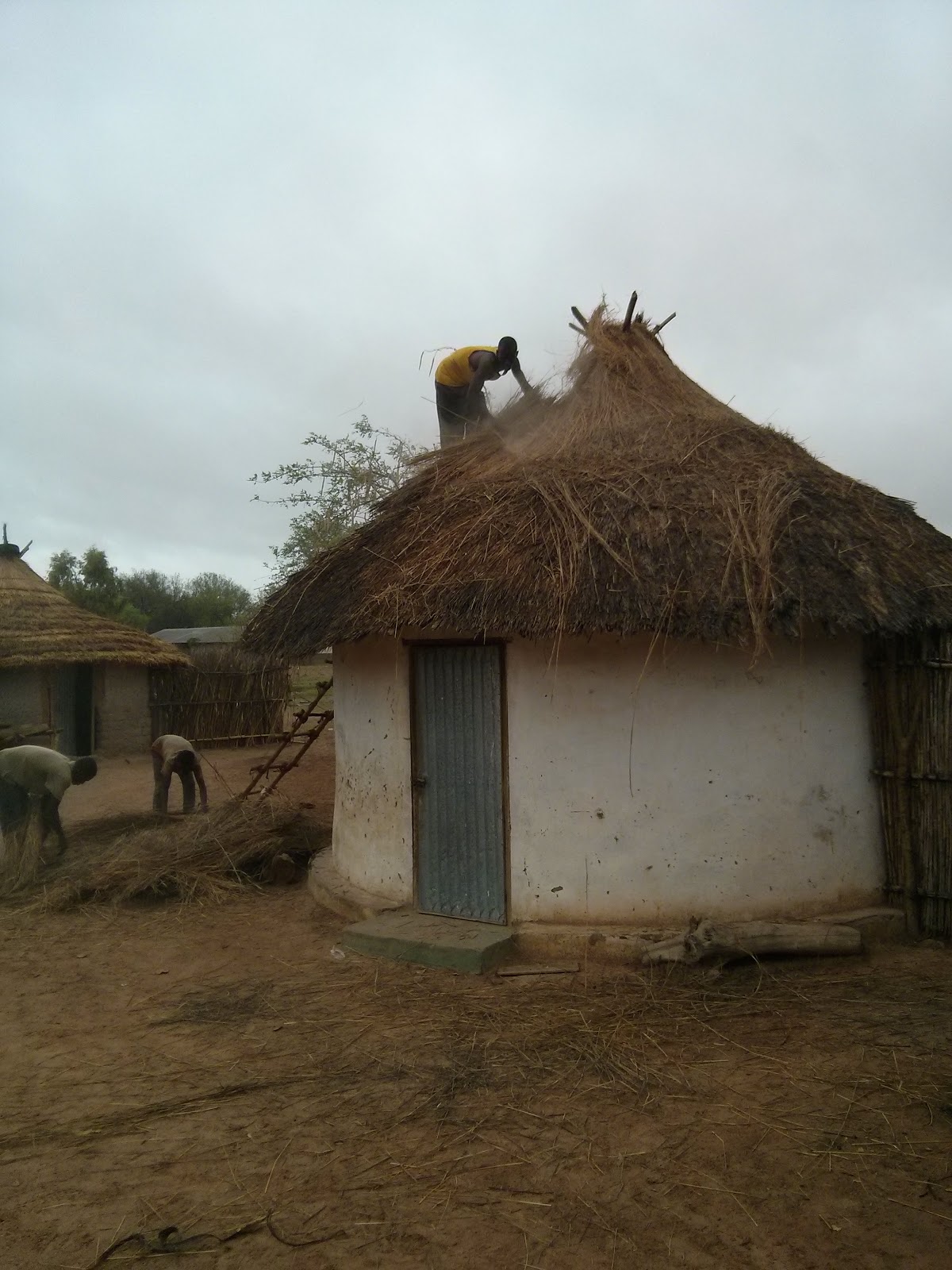
The old roof coming off
 My brother and uncle unrolling grass
The roof almost done
What it looked like inside

Just before the rainy season my dad had my brothers put a new roof on my hut. The old one seemed to me to be working just fine, but everyone who came over would mention that it was old and should be replaced. There was only one spot where water came in, but every time I left, lots of dust and stray grass would fall down on the floor. The roof is made from a thick, long grass. Its not the nice soft stuff that grows around town. It comes from the swamp and is pretty thick. After the harvest and rainy season are over, people will pass by the swamp as often as possible to cut a donkey cart full of grass and bring it home. They leave it out for a while, and then they start tying it together by braiding a long peice of bark through a handful of grass at a time. When they finish the grass lays out like a long rug, and then it gets rolled up and put on top of the donkey house until its reasy to be used. All of the thatched roof huts have to be replaced every few years, and there are a few others in my compound that seem worse off than mine. The rains werent very heavy last year, and so there wasnt as much grass available this year. Since Im the guest I got the new roof, while  others just got some patches. My unle and brother began by climbing up to the very top of my roof, then  they just start rolling the sheets of grass off and throwing it down. On the ground my uncles kids and my other brother roll it back up, and carry it off to use for something else. They peeled it all the way down the last few layers, and then they knocked the frames all over with a hammer to knock off all the termites and dust. Then one by one a fresh roll of grass gets thrown up and rolled out, until it reaches the top. The top point is then tied together and bound either with a bottomless bowl, or old tire. The alternative to these grass roofs is corrugate. The corrugate buildings get really hot during the day in the hot season, and I wondered why anybbody would want one. After seeing all the work it takes to replace a grass roof though, I understand.

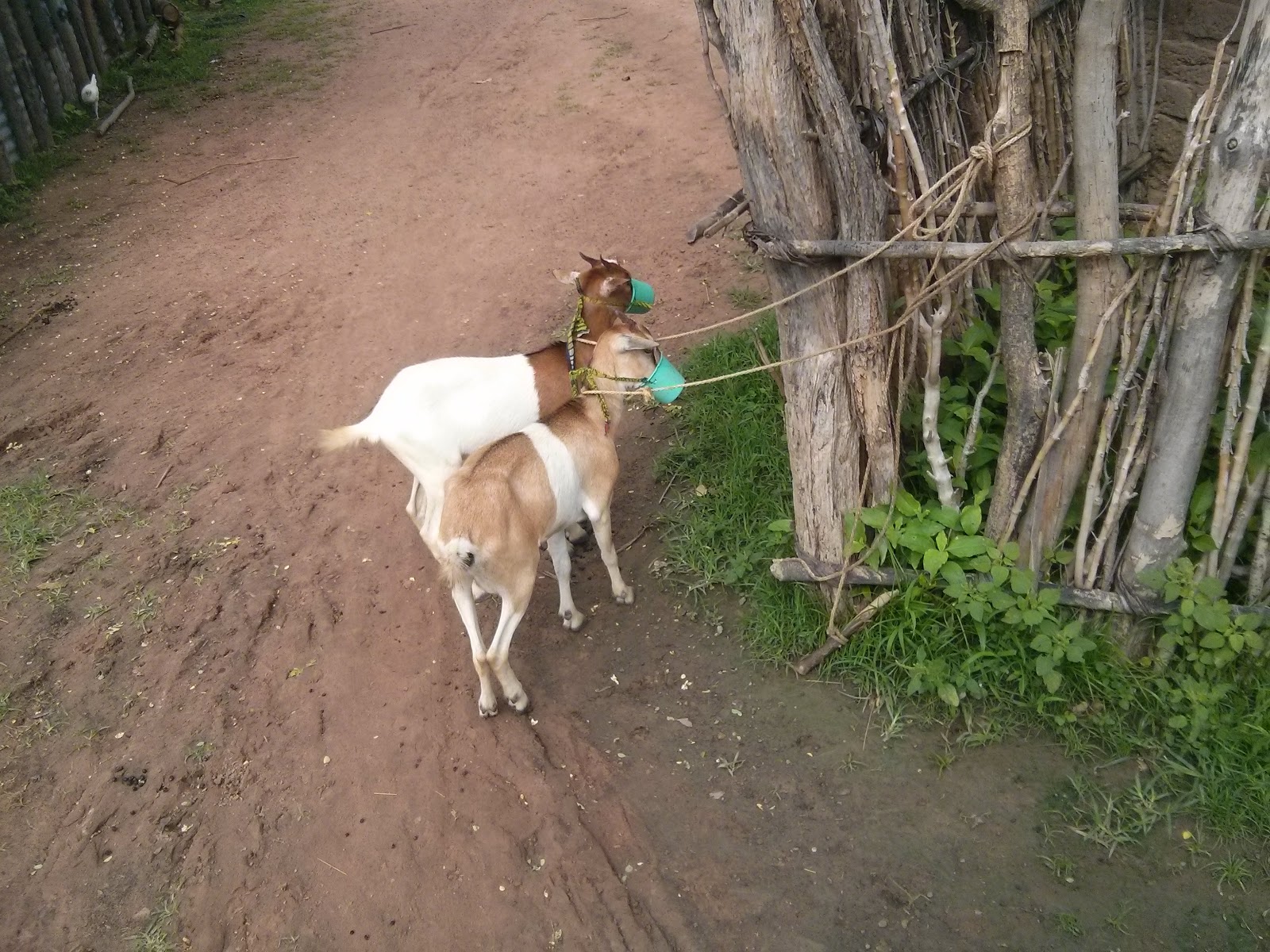
Killer Goats


The above goats are muzzled and tied to the fence. They are muzzled with plastic cups, that have holes punched in each side and a string tied through the holes. They look kind of like the oxygen masks that are supposed to drop down on you in an airplane cabin. Most of the time all the masks are hanging in the women´s huts. When the women head to their oeanut field in the morning, they will take all their goats with them. They tie them up with these masks though to keep them from eating peanuts, corn, and millet as they make their way out to the field. Once they get out to the field they will tie them up near a patch of green grass and take the mask off, letting the sheep or goats graze while the women work in the field. During the dry season all of the animals are left to their own devices. When they wake up in the morning they all leave, and return slowly in the evening. The only help they get is a bucket of water when they get home, or congregate near the well. Once the crops are planted and start to come up, a village law goes into effect that all animals have to be tied up. If you find someone elses animal ranging free, you are suposed to corral them and take them to the alkalo (village mayor). The owner has to pay 25Dalasi to collect the animal. It seems to me most people avoid this fine and take the animal straight to the owner. There they often yell at the owner and tell them that next time its staright to the alkalo.


Friday, July 3, 2015

Tida's New Baby

While Zabeth and I were gone for some errands and a weekend in Basse a new baby was born in our compound. It is my dad’s son Sinjang Sanuwo and his wife Tida Fatty’s second baby. The first is a stout little girl about three years old named Fatou. Sinjang is actually not home right now. He came for last year’s rainy season, and then after the work was done returned to Senegal to work in a town called Kaolack. We came back from Basse on Saturday June 13th, and the baby had arrived early that morning. It was a baby boy, born in our compound in the hut almost right across from mine. When a baby is born here it is not named right away. It is just called new boy, or new girl. Most people that come by and see it will also call it ugly and tell the mom to throw it away. It’s a superstition that if the baby is cherished or complimented that it will be taken away, so no one is offended by the back handed compliments. For one week the baby won’t have a name and the mother will sit in the room with the baby without leaving. During that week people are coming by to greet and hold the baby and check on the new mom. I personally liked to go and hold the baby after dinner and relaxing, the last thing before going in for the night. On the one week anniversary of the birth, there will be a naming ceremony which is a nice one day party. The elders come over and shave off all the baby’s hair and then it’s got a name. Since Tida’s new baby was born right before Ramadan and his naming ceremony fell during the fast,  the party would have been kind of subdued. So it is delayed until Sinjang comes home and the fast is over.  It still gets a name though and Tida still got dressed up to walk around the compound and village, introducing people to her new son Musa.
 Zabeth and I holding Musa, and Tida standing behind Fatou
Paige, my neighbor in Garawol came down to see the baby

 The baby, Musa Sanuwo

Tuesday, June 30, 2015

The Saint Louis Jazz Festival

On Tuesday night, May 20th or so Zabeth and I met up with my friends Alyssa and Lizzie in Farafenni so that Wednesday morning we could all catch a car together up to the town of Saint Louis in Northern Senegal. We joined a car leaving from the border around 9 am, and drove all day to reach St. Louis by around 6 that night. When we got in we checked into a small hostel, and were the second group out of 16 total volunteers to arrive. We grabbed space in a big room that had twelve single beds lined up wall to wall, and made our home for the next five nights. After cleaning up we all went straight out to check out the town. St. Louis was the capital of French West Africa until 1904, so it got alot of foreign interaction in it's day, and that's still the case today. The town is actually on a small island that sits right off the coast and is connected by bridge to a large city called N'Dar. As an international tourist destination, and historical site the town has restaurants, bars, full time electricity, shopping, pastries and coffee shops, and alot of amenities you expect to find in Ruidoso, but can be pretty surprising to see after a 9 hour car ride into the edge of the Sahara Desert. Logically we wasted no time indulging, and after quickly getting pizza and beer for dinner we made our way to the first, and only free, night of the festival. We watched a band called the Baobab Orchestra start at ten pm and play until midnight. When hearing that it was a festival, I initially expected a park, open air, tents, and all day music. The actual schedule though wasnt that hard to adapt to. Each night, one or two bands would play until midnight on a central stage. Then, the best part was that after the main show, there were several venues around town where you could catch jazz acts from midnight until 2am, and then another set from 2 to 4 am. After one night of staying out til 4, we quickly got in a habit of sleeping in and laying low during the day. We would rouse around 12, take a walk on the town to find some snacks, and then take an afternoon nap. We would get ready, go to dinner, and then drink some gin and tonic and play cards until the free shows started. We made certain to catch the main acts of the last two nights. The festival finale was an awesome show, worth both paying for and waiting five days to see. They were a french band, but played in English and were called Malted Milk. They played over the usual 12 stop time, and had the entire crowd up in fornt of the stage until 2 am on Sunday night. It was a great way to end the week, before we got up three hours later and caught a car back to Gambia.
 
Lizzie, Alyssa, and I having some coffee in the evening on the balcony of our hostel

 Getting my beard trimmed a the local coiuffuer
Playing cards and having a cocktail before we go out to see the festival

 With my buddies at the north end of the island
Me and Zabeth on the bridge

Neeto

The African Locust bean is my favorite tree. The particular one I like sits in a field about 100 yards from my compound and the edge of town. Its my favorite of the trees here because although its a giant, it still has tiny little leaves like a mesquite. It is starting to make fruit, which look like little ornaments. The stem of the fruit hangs down and the fruit itself is a perfect circle. After it fruits, it will produce seeds that look like mesquite bean pods, long slender shells full of beans. But, surrounding the seeds are this powdery yellow stuff called locally "Netto" the same as the tree. It is mixed with peanut butter and sugar for a snack. People say they know the rains are coming when the seeds are ready. In this particular tree are a wild hive of bees. On a branch about 3/4 of the way up the tree is a hole, and protruding from the hole is about ten combs that look just like ribs. The wind is picking up and making the bees mad, and just above the hive is a lizard sitting waiting to pick off errant bees.

Friday, April 3, 2015

My Dad's Gun

My host dads gun would definitely be right at home in an antique show. I thought it was some leftover artifact from a hunting expedition or World War. He loads black powder, rocks, bearings, or b.b.s and ignites it with a blasting cap that sets on top of the gun. I just learned that the gun is actually not a relic or hand me own, but rather hand made in a town north of the river. My dad just spent two days travelling there to get some parts replaced. He uses his gun on nights when the fish arent in season to still bring some protein to meals. While everyone else is eating dinner and getting ready to settle in, he is loading up and getting ready to go to the bush. He hunts for a grouse, or guinea fowl which is called a bush chicken or locally a wuolo. On a good night he brings home four or five, and they replace fish with our millet and peanut sauce the next day at lunch. He's always tired when I greet him on those mornings when he brings the birds out to show. He doesn't come home until the moon comes up and blows his cover. Then he eats dinner alone while the rest of us are getting to sleep.
My dad making bullets by placing his machete on a long metal rod, then hammering the machete to slice off a piece the size of a b.b.

Thursday, March 5, 2015

My Dad Visits: A Travel Journal

Day 1: I felt really bad because I was an hour and a half late picking my dad up at the airport. The driver is a friend  who really wanted to be there to pick my dad up, but he had to take his brothers and sisters home from school before he could drive to the airport. We came to a small hotel on the beach and got right to catching up and smoking a cigar. Then we took a walk to get my bag from the Peace Corps house and stayed up talking some more while he unpacked. I neglected to put the mosquito net down when going to bed, and found a large population resting on the wall in the middle of the night.

Day 2: I brought my dad some breakfast, but he slept til 11 and wasn’t in the mood for food anyways. We left the beach and walked up to see the Peace Corps office. He got to meet the Country Director and a few other really nice people. As we were leaving the deputy chief invited us to ride with her down to the Peace Corps house to look around. We had a slice of carrot cake and club soda then went back to the beach and smoked two more cigars. We walked down the beach a bit and then got ready and went out to dinner with my friends Beth, Lizzie, and Alyssa.

Day 3: My dad slept in again while I had coffee and breakfast. When he finally rose we packed our bags for the trip the next day out of Kombo, leaving his big suitcase behind. We left the beach and had a local lunch, my dads first Gambian food was rice and peanut sauce. We walked to the countries best bookstore and drank a cappuccino on the beach. It was too early for dinner so we went to another beachside spot and watched the fishing boats going out. Then we went back to our hotel and met a small group of volunteers. We smoked cigars while the sun went down. We dropped my dad’s bag at the Peace Corps house then walked into a small neighborhood and met Alyssa for another local dinner of beans and cassava. Then we went and found sweet rolls for dessert.

Day 4: We took a cab to the bus station and got out of Kombo. We rode halfway up the country to the town of Soma, took a cab to the river and crossed on the ferry, then took another cab up to the town of Farafenni. We found a guesthouse called Eddie’s. There were two volunteers drinking soda, and we sat with them and cooled off from travel. Then we had lunch and came back and spent the afternoon smoking cigars in the courtyard. At night, Stephen and Rebecca came over and we visited with them. Then Stephen took us out and we walked around exploring Farafenni. We got bean sandwiches on hot fresh bread for dinner, and ate them in the dark sitting on the road.

Day 5: We were up close to seven and at the bus station to leave Farafenni by 8. We got off at Wassu and walked a few kilometers to the riverside town of Kuntaur. A boat from Baboon Island National Park picked us up shortly after noon. We rode back to their camp, and when we got there had juice and lunch, while the administrator told us about the Chimpanzee Rehabilitation Project. After lunch we went out on a boat ride  and saw baboons, chimps, a few crocodiles, and some hippos, and a lot of birds. After the boat ride we sat on the porch of the camp. We had dinner and chatted with another guest. My dad excused us to go up to our tent, where we sat outside on the lawn chairs smoking cigars and looking out at the night sky and the river Gambia.


Day 6: The camp brought us hot water at 7 am, and we had coffee and then went out on a walk to look at birds. We came back, had breakfast, and then caught the same boat back to Kuntaur. When we got to town, we took a donkey cart to Wassu, moved into a vehicle, and drove to the ferry crossing in Janjanbureh. There we caught a bus to Basse. We walked to the house and smoked a cigar, then my friend Lamin Sorra came over to greet my dad. We cleaned up and enjoyed having power and internet, and I made eggs and instant potatoes for dinner.


Day 7: We went to the car park and asked for a ride to Garawol . The vehicle wasn’t ready, but waiting in the car park in the few hours was really enjoyable because I had my dad with me. We rode to my village and everyone came out to meet us. Some of my favorite people in the village came by to greet my dad, and then my family let us relax in the backyard for most of the night.

Day 8: My dad and I rode up to see Garawol and buy a bag of rice. Then we came back and got to relax a little before a big group of women from the village came by to greet and dance for my dad. After the dance we rode with my uncle Salung to the riverside to watch him fish and relax a little. When we came back my dad gave my host dad some gifts from America and we spent the evening in the backyard.

Day 9: I took my dad on a big bike ride to Fatoto. I wanted him to meet my favorite people from the maket, Hawa and Bakary. We drank some cold water and ate some bread. On the way home we stopped and climbed a hill that looked out over the nearby villages. I use the hill for its phone service and it was special to be up there with my dad instead of being up there to call him. When we got home my dad fell asleep and then lunch came. In the afternoon we just went outside and sat under the shade tree. We packed up to leave early the next morning and all my host mothers brought peanuts to the room for my dad to take home.

Day 10: We left my village dark and early around 5:15. We rode to Paige’s house in Garawol and left our bikes then all went to catch a vehicle together. We made Basse around 8am and were the first group on the bus back to Kombo. We made it in aroun 3 pm and I left my dad drinking coffee to go retrieve his bags and hail a cab to drive us to Kartong. We changed cabs three times, but were delivered to our resort at dinner time. As soon as we arrived they showed us to our room and took our dinner order. There was a man sitting in the dining room with his shirt off getting a massage. My dad saw that, and then the room we were given, and agreed this place would suffice. We cleaned up for dinner, and the electrical socket caught on fire.


Day 11: We had breakfast and coffee, then went to the beach and got some sun. Our only chore was to come back and have lunch. My dad smoked a cigar while laying in the hammock. Around 5 we went down and walked the beach for a while. Then it was time to go to dinner. A very nice British lady named Pavanne came over and said hi to us, as did the owner of the resort. It turned out that the night watchman was also the masseuse.

Day 12: After breakfast and coffee we went to the beach. There were four or five other guests there as well. An hour in the sun and we went back to the room and relaxed before lunch with some more hammock and cigar time for my dad. We went back to the dining room in the afternoon and my dad had a really nice talk with Pavanne. That carried the day into the night and it was time for dinner, reading, and relaxing.


Day 13: Another coffee and breakfast morning, then to the beach for a dose of Vitamin D. It was more melancholy today as the trip was ending. It wasn’t just the three days in the resort that were a vacation, it was the whole time my dad was here. The resort was nice enough to let us spend the whole day in our room while waiting for the evening flight departure. So after lunch and some hammock time we both packed up, and walked back down to the restaurant. The taxi came around 5 pm, and the staff on hand at the resort all lined up on the sidewalk to wave us goodbye. I got out of the cab and walked my dad into the airport and said goodbye.