Sunday, November 8, 2015

Our Gambian Wedding

Dillon and my recognized union as partners in the form of a Gambian wedding has been 8 years in the making, felt right, and was nice while not having to confront a fear of legalized U.S. marriage. It was also slightly pushed on us from Dillon's Gambian family because they wanted to have an excuse for a party and to have their beloved Dillon married under the eyes of the village. The first step we took was finding wedding fabric we could agree on, and getting fitted at a tailor. Next, Dillon and I made a list of needed items to feed people for 2-3 days: compound residents, guests, village visitors. I would have been stressed, but we just  arranged a donkey cart to meet us in the nearest town, Garawol, to haul the goods back to Sami Koto: Palm oil, rice, mayonnaise, tea (attaya), sugar, evaporated milk, produce, huge tub of peanut butter, and some matching head wraps for the family. We also arranged with his host father to have a resident goat be slaughtered for the event, of which I watched in the main courtyard. The food was really good, and the women worked really hard in the heat of the day cooking all this food over a fire.

Dillon also had a meeting with his family about Mandinka wedding rituals and which one's we felt comfortable with. One tradition is where the bride is taken into the bush and washed by an elder and told the village secrets. This would have been super cool, however, I can't understand a lick of Mandinka and they would not allow any non village women translators to come with me. And I wasn't sure all what "washing" entailed. The second one is where the bride has to stay in her hut for a week after the wedding. After Dillon and I visited two other Gambian brides, I decided this wasn't my cup of tea. It was so hot, the brides were exhausted from guests in their room, and I was already going out on a limb here.

Slowly Dillon's friends, of whom I became really close to, started arriving to Sami Koto. The first day three Peace Corps lady friends showed up to help me during the time when I was to be alone with village women (Dillon and I weren't supposed to see each other) by translating, and helping me figure out what the hell is going on. The first day we all dyed our feet in -Dillon’s sister- Seedah's hut with henna dye. It was really cool looking! Then once it cooled off enough all the women got together and started drumming and dancing! Dill and I were still not supposed to see each other, so we slept separately that night. At  2am, I could hear music, so a few of us wandered to the center of the village where two other brides were sitting and watching a bush monster dance.. It was really bizarre, but also also quite beautiful. The next day was the actual marriage, I didn’t know of any plan or organizing of the event, things just happened when they did and not in any specific order. Me and my cohorts were ushered into the middle of the compound where Seedah braided my hair. She is the best in town. I think it was really hard for her because of the obvious difference in hair texture and it was her first time working with my hair type. After a few hours, I was rushed off with a bunch of Gambian women and Dillon’s mom's to a random compound. It was funny because I could tell they wanted to be careful with me and weren't sure how to go about changing me into my wedding clothes. They put on my skirt, shirt, (Dill's mom sewed for me) put jewelery on me and then as a final touch covered my head with a hot, thick material. The fabric was really nice, but also turned my skin blue, so we joked about my similarity to an avatar. I met the two other brides outside, and as a huge group of women we walked to all the compounds in the village. We would go to each man in the compound, usually the grandfathers, and would bow to them. They would give each bride 5 to 10 dalasai (money). This whole time I was tripping, holding on to the woman next to me because I can hardly see under the head garb. Then, to my surprise I am led to another compound where there are a bunch of curious on-lookers waiting to greet me, the other brides, and to get a look at the other American guests. This time period is traditionally when the grooms are to search the village, like an easter egg hunt, for their bride. Haha but this message was not relayed to my groom. I sat there with my good friends Beth, Alyssa, Lizzie, and Paige laughing and kind of sighing in relief that nothing crazy happened. The last part of the wedding was actually meeting up with Dillon. We all walked back to Dill's compound and met him, but first, I had to "bow" to all the father's and mother's of the compound. Everything is kind of a blur after that, but I do remember a lot of of guests, I mean a lot, came to our hut to congratulate us and then a day or two after Dillon and I made our rounds to the New and Old Sami in our wedding garb. People were really nice and wanted to talk to us and also were generous by giving us bags of peanuts, and money. 

The rest of the time that I was in Gambia, I always wore my wedding necklaces and noticed I was treated differently. Women would randomly grab and admire them, calling out MANYO (bride), and I think people just appreciated that we respected their marriage traditions. Our Gambian honey moon was spent appreciating Gambia's own Stone Circles - Wasu, visiting PC friend's villages, getting a 101 african beekeeping lesson at BeeCause, and lastly spending a few days at an eco-resort called Sandele! 


Monday, October 26, 2015

the Town Weeding

All the men weeding the town, just in front of our compound.


During the dry season, all of the unmarried men and women meet every Thursday morning to sweep the town. Its called Sate Fito- or town sweep. They tackle all the main streets, and a few side ones. The trash and leaves they sweep up will eventually blow back in by the time the next week rolls around, but thats okay. After breakfast someone will go through town with a whistle that notifies everybody to meet in the center of town and start work. The men carry rakes, and the women bring brooms, dustpans, and buckets to put the trash in. The men go first and rake everything into piles, then the women come behind, sweep up the piles and take them out of town. Since the rain started, all of the work has been on the farm, so no one was around and the tradition kind of dies down for a while. With the rains though, also come alot of weeds. So the edges of all the paths in town were grown over in grass. After all the fields are plowed, planted, and then weeded there is a little break from farming while plants mature and people gather their strength for the harvest. It also is a little time to catch back up on town chores. On this day all the men, married or not, went through the whole town weeding. Sate Baro it was called. It was the week before Tobaski, the biggest holiday here. We had a fresh town to celebrate on. Our compound is at the far end of town, once people reach our door they are done for the day. Consequently, the job is not always super thorough, but the town looks nice.

Tuesday, August 25, 2015

A New Roof

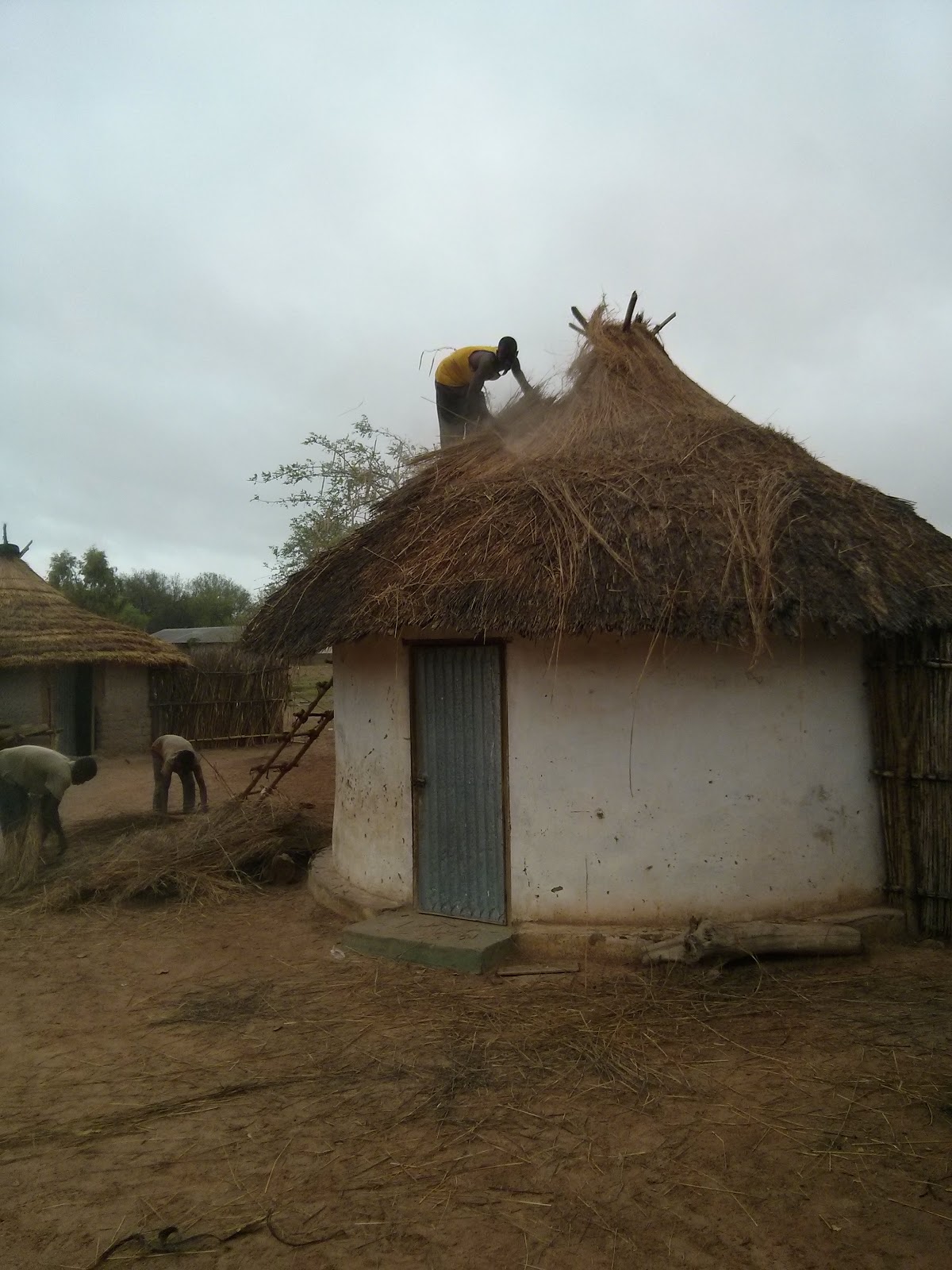
The old roof coming off
 My brother and uncle unrolling grass
The roof almost done
What it looked like inside

Just before the rainy season my dad had my brothers put a new roof on my hut. The old one seemed to me to be working just fine, but everyone who came over would mention that it was old and should be replaced. There was only one spot where water came in, but every time I left, lots of dust and stray grass would fall down on the floor. The roof is made from a thick, long grass. Its not the nice soft stuff that grows around town. It comes from the swamp and is pretty thick. After the harvest and rainy season are over, people will pass by the swamp as often as possible to cut a donkey cart full of grass and bring it home. They leave it out for a while, and then they start tying it together by braiding a long peice of bark through a handful of grass at a time. When they finish the grass lays out like a long rug, and then it gets rolled up and put on top of the donkey house until its reasy to be used. All of the thatched roof huts have to be replaced every few years, and there are a few others in my compound that seem worse off than mine. The rains werent very heavy last year, and so there wasnt as much grass available this year. Since Im the guest I got the new roof, while  others just got some patches. My unle and brother began by climbing up to the very top of my roof, then  they just start rolling the sheets of grass off and throwing it down. On the ground my uncles kids and my other brother roll it back up, and carry it off to use for something else. They peeled it all the way down the last few layers, and then they knocked the frames all over with a hammer to knock off all the termites and dust. Then one by one a fresh roll of grass gets thrown up and rolled out, until it reaches the top. The top point is then tied together and bound either with a bottomless bowl, or old tire. The alternative to these grass roofs is corrugate. The corrugate buildings get really hot during the day in the hot season, and I wondered why anybbody would want one. After seeing all the work it takes to replace a grass roof though, I understand.

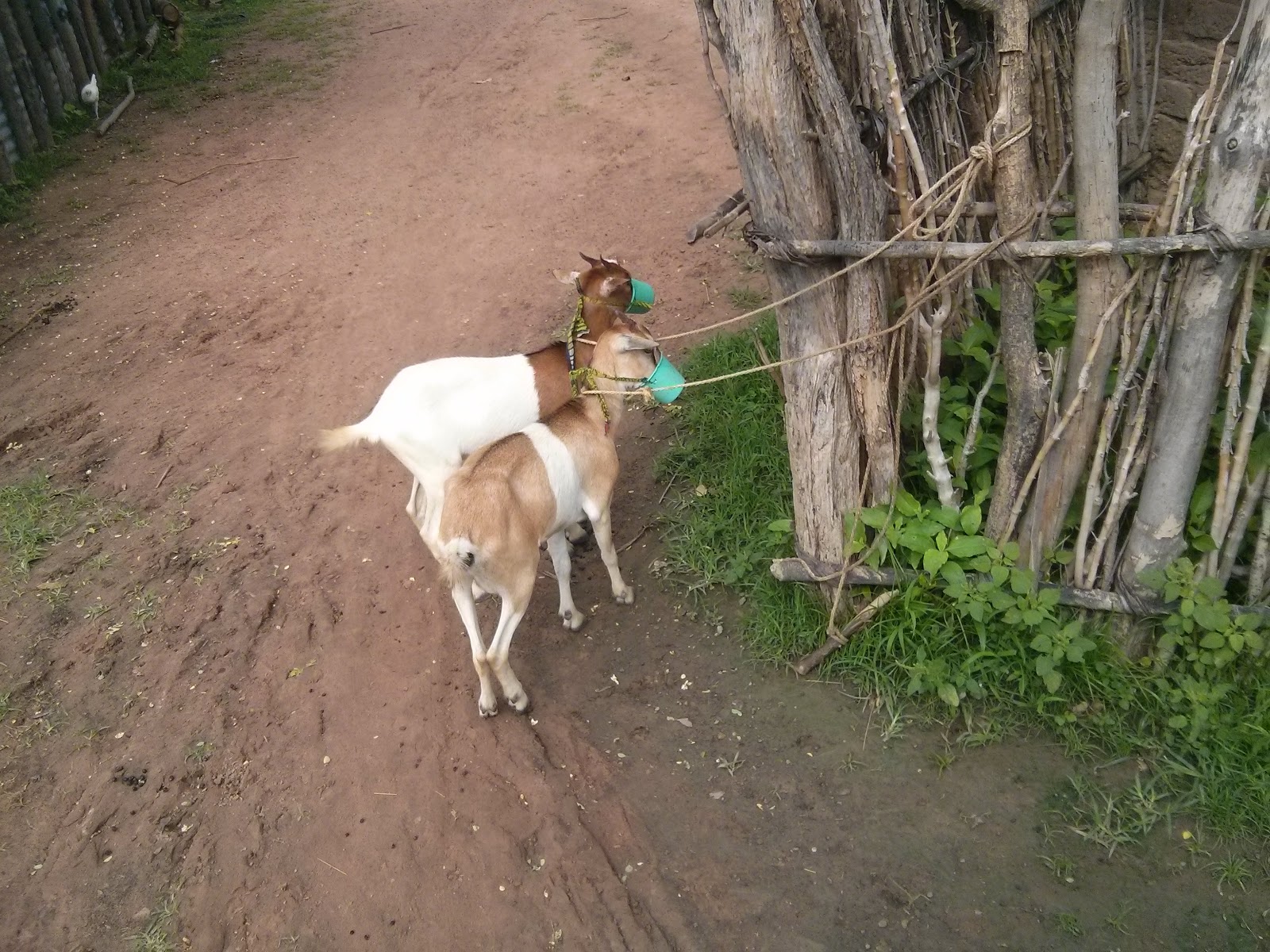
Killer Goats


The above goats are muzzled and tied to the fence. They are muzzled with plastic cups, that have holes punched in each side and a string tied through the holes. They look kind of like the oxygen masks that are supposed to drop down on you in an airplane cabin. Most of the time all the masks are hanging in the women´s huts. When the women head to their oeanut field in the morning, they will take all their goats with them. They tie them up with these masks though to keep them from eating peanuts, corn, and millet as they make their way out to the field. Once they get out to the field they will tie them up near a patch of green grass and take the mask off, letting the sheep or goats graze while the women work in the field. During the dry season all of the animals are left to their own devices. When they wake up in the morning they all leave, and return slowly in the evening. The only help they get is a bucket of water when they get home, or congregate near the well. Once the crops are planted and start to come up, a village law goes into effect that all animals have to be tied up. If you find someone elses animal ranging free, you are suposed to corral them and take them to the alkalo (village mayor). The owner has to pay 25Dalasi to collect the animal. It seems to me most people avoid this fine and take the animal straight to the owner. There they often yell at the owner and tell them that next time its staright to the alkalo.


Friday, July 3, 2015

Tida's New Baby

While Zabeth and I were gone for some errands and a weekend in Basse a new baby was born in our compound. It is my dad’s son Sinjang Sanuwo and his wife Tida Fatty’s second baby. The first is a stout little girl about three years old named Fatou. Sinjang is actually not home right now. He came for last year’s rainy season, and then after the work was done returned to Senegal to work in a town called Kaolack. We came back from Basse on Saturday June 13th, and the baby had arrived early that morning. It was a baby boy, born in our compound in the hut almost right across from mine. When a baby is born here it is not named right away. It is just called new boy, or new girl. Most people that come by and see it will also call it ugly and tell the mom to throw it away. It’s a superstition that if the baby is cherished or complimented that it will be taken away, so no one is offended by the back handed compliments. For one week the baby won’t have a name and the mother will sit in the room with the baby without leaving. During that week people are coming by to greet and hold the baby and check on the new mom. I personally liked to go and hold the baby after dinner and relaxing, the last thing before going in for the night. On the one week anniversary of the birth, there will be a naming ceremony which is a nice one day party. The elders come over and shave off all the baby’s hair and then it’s got a name. Since Tida’s new baby was born right before Ramadan and his naming ceremony fell during the fast,  the party would have been kind of subdued. So it is delayed until Sinjang comes home and the fast is over.  It still gets a name though and Tida still got dressed up to walk around the compound and village, introducing people to her new son Musa.
 Zabeth and I holding Musa, and Tida standing behind Fatou
Paige, my neighbor in Garawol came down to see the baby

 The baby, Musa Sanuwo

Tuesday, June 30, 2015

The Saint Louis Jazz Festival

On Tuesday night, May 20th or so Zabeth and I met up with my friends Alyssa and Lizzie in Farafenni so that Wednesday morning we could all catch a car together up to the town of Saint Louis in Northern Senegal. We joined a car leaving from the border around 9 am, and drove all day to reach St. Louis by around 6 that night. When we got in we checked into a small hostel, and were the second group out of 16 total volunteers to arrive. We grabbed space in a big room that had twelve single beds lined up wall to wall, and made our home for the next five nights. After cleaning up we all went straight out to check out the town. St. Louis was the capital of French West Africa until 1904, so it got alot of foreign interaction in it's day, and that's still the case today. The town is actually on a small island that sits right off the coast and is connected by bridge to a large city called N'Dar. As an international tourist destination, and historical site the town has restaurants, bars, full time electricity, shopping, pastries and coffee shops, and alot of amenities you expect to find in Ruidoso, but can be pretty surprising to see after a 9 hour car ride into the edge of the Sahara Desert. Logically we wasted no time indulging, and after quickly getting pizza and beer for dinner we made our way to the first, and only free, night of the festival. We watched a band called the Baobab Orchestra start at ten pm and play until midnight. When hearing that it was a festival, I initially expected a park, open air, tents, and all day music. The actual schedule though wasnt that hard to adapt to. Each night, one or two bands would play until midnight on a central stage. Then, the best part was that after the main show, there were several venues around town where you could catch jazz acts from midnight until 2am, and then another set from 2 to 4 am. After one night of staying out til 4, we quickly got in a habit of sleeping in and laying low during the day. We would rouse around 12, take a walk on the town to find some snacks, and then take an afternoon nap. We would get ready, go to dinner, and then drink some gin and tonic and play cards until the free shows started. We made certain to catch the main acts of the last two nights. The festival finale was an awesome show, worth both paying for and waiting five days to see. They were a french band, but played in English and were called Malted Milk. They played over the usual 12 stop time, and had the entire crowd up in fornt of the stage until 2 am on Sunday night. It was a great way to end the week, before we got up three hours later and caught a car back to Gambia.
 
Lizzie, Alyssa, and I having some coffee in the evening on the balcony of our hostel

 Getting my beard trimmed a the local coiuffuer
Playing cards and having a cocktail before we go out to see the festival

 With my buddies at the north end of the island
Me and Zabeth on the bridge

Neeto

The African Locust bean is my favorite tree. The particular one I like sits in a field about 100 yards from my compound and the edge of town. Its my favorite of the trees here because although its a giant, it still has tiny little leaves like a mesquite. It is starting to make fruit, which look like little ornaments. The stem of the fruit hangs down and the fruit itself is a perfect circle. After it fruits, it will produce seeds that look like mesquite bean pods, long slender shells full of beans. But, surrounding the seeds are this powdery yellow stuff called locally "Netto" the same as the tree. It is mixed with peanut butter and sugar for a snack. People say they know the rains are coming when the seeds are ready. In this particular tree are a wild hive of bees. On a branch about 3/4 of the way up the tree is a hole, and protruding from the hole is about ten combs that look just like ribs. The wind is picking up and making the bees mad, and just above the hive is a lizard sitting waiting to pick off errant bees.