Then I walked in, walked up to him, and we just greeted each other for about 30 minutes. He got out his phone and called home, and told everybody in his compound that I was there visiting him. It was late on Sunday night, but we walked around the craft market and he introduced me to all of his friends there. We talked for another few minutes before I said goodbye, and started to make my own way back home.
Tuesday, January 19, 2016
In New York
Then I walked in, walked up to him, and we just greeted each other for about 30 minutes. He got out his phone and called home, and told everybody in his compound that I was there visiting him. It was late on Sunday night, but we walked around the craft market and he introduced me to all of his friends there. We talked for another few minutes before I said goodbye, and started to make my own way back home.
Bitiks
Sunday, November 8, 2015
Our Gambian Wedding
Dillon also had a meeting with his family about Mandinka wedding rituals and which one's we felt comfortable with. One tradition is where the bride is taken into the bush and washed by an elder and told the village secrets. This would have been super cool, however, I can't understand a lick of Mandinka and they would not allow any non village women translators to come with me. And I wasn't sure all what "washing" entailed. The second one is where the bride has to stay in her hut for a week after the wedding. After Dillon and I visited two other Gambian brides, I decided this wasn't my cup of tea. It was so hot, the brides were exhausted from guests in their room, and I was already going out on a limb here.
Slowly Dillon's friends, of whom I became really close to, started arriving to Sami Koto. The first day three Peace Corps lady friends showed up to help me during the time when I was to be alone with village women (Dillon and I weren't supposed to see each other) by translating, and helping me figure out what the hell is going on. The first day we all dyed our feet in -Dillon’s sister- Seedah's hut with henna dye. It was really cool looking! Then once it cooled off enough all the women got together and started drumming and dancing! Dill and I were still not supposed to see each other, so we slept separately that night. At 2am, I could hear music, so a few of us wandered to the center of the village where two other brides were sitting and watching a bush monster dance.. It was really bizarre, but also also quite beautiful. The next day was the actual marriage, I didn’t know of any plan or organizing of the event, things just happened when they did and not in any specific order. Me and my cohorts were ushered into the middle of the compound where Seedah braided my hair. She is the best in town. I think it was really hard for her because of the obvious difference in hair texture and it was her first time working with my hair type. After a few hours, I was rushed off with a bunch of Gambian women and Dillon’s mom's to a random compound. It was funny because I could tell they wanted to be careful with me and weren't sure how to go about changing me into my wedding clothes. They put on my skirt, shirt, (Dill's mom sewed for me) put jewelery on me and then as a final touch covered my head with a hot, thick material. The fabric was really nice, but also turned my skin blue, so we joked about my similarity to an avatar. I met the two other brides outside, and as a huge group of women we walked to all the compounds in the village. We would go to each man in the compound, usually the grandfathers, and would bow to them. They would give each bride 5 to 10 dalasai (money). This whole time I was tripping, holding on to the woman next to me because I can hardly see under the head garb. Then, to my surprise I am led to another compound where there are a bunch of curious on-lookers waiting to greet me, the other brides, and to get a look at the other American guests. This time period is traditionally when the grooms are to search the village, like an easter egg hunt, for their bride. Haha but this message was not relayed to my groom. I sat there with my good friends Beth, Alyssa, Lizzie, and Paige laughing and kind of sighing in relief that nothing crazy happened. The last part of the wedding was actually meeting up with Dillon. We all walked back to Dill's compound and met him, but first, I had to "bow" to all the father's and mother's of the compound. Everything is kind of a blur after that, but I do remember a lot of of guests, I mean a lot, came to our hut to congratulate us and then a day or two after Dillon and I made our rounds to the New and Old Sami in our wedding garb. People were really nice and wanted to talk to us and also were generous by giving us bags of peanuts, and money.


Monday, October 26, 2015
the Town Weeding
During the dry season, all of the unmarried men and women meet every Thursday morning to sweep the town. Its called Sate Fito- or town sweep. They tackle all the main streets, and a few side ones. The trash and leaves they sweep up will eventually blow back in by the time the next week rolls around, but thats okay. After breakfast someone will go through town with a whistle that notifies everybody to meet in the center of town and start work. The men carry rakes, and the women bring brooms, dustpans, and buckets to put the trash in. The men go first and rake everything into piles, then the women come behind, sweep up the piles and take them out of town. Since the rain started, all of the work has been on the farm, so no one was around and the tradition kind of dies down for a while. With the rains though, also come alot of weeds. So the edges of all the paths in town were grown over in grass. After all the fields are plowed, planted, and then weeded there is a little break from farming while plants mature and people gather their strength for the harvest. It also is a little time to catch back up on town chores. On this day all the men, married or not, went through the whole town weeding. Sate Baro it was called. It was the week before Tobaski, the biggest holiday here. We had a fresh town to celebrate on. Our compound is at the far end of town, once people reach our door they are done for the day. Consequently, the job is not always super thorough, but the town looks nice.
Tuesday, August 25, 2015
A New Roof
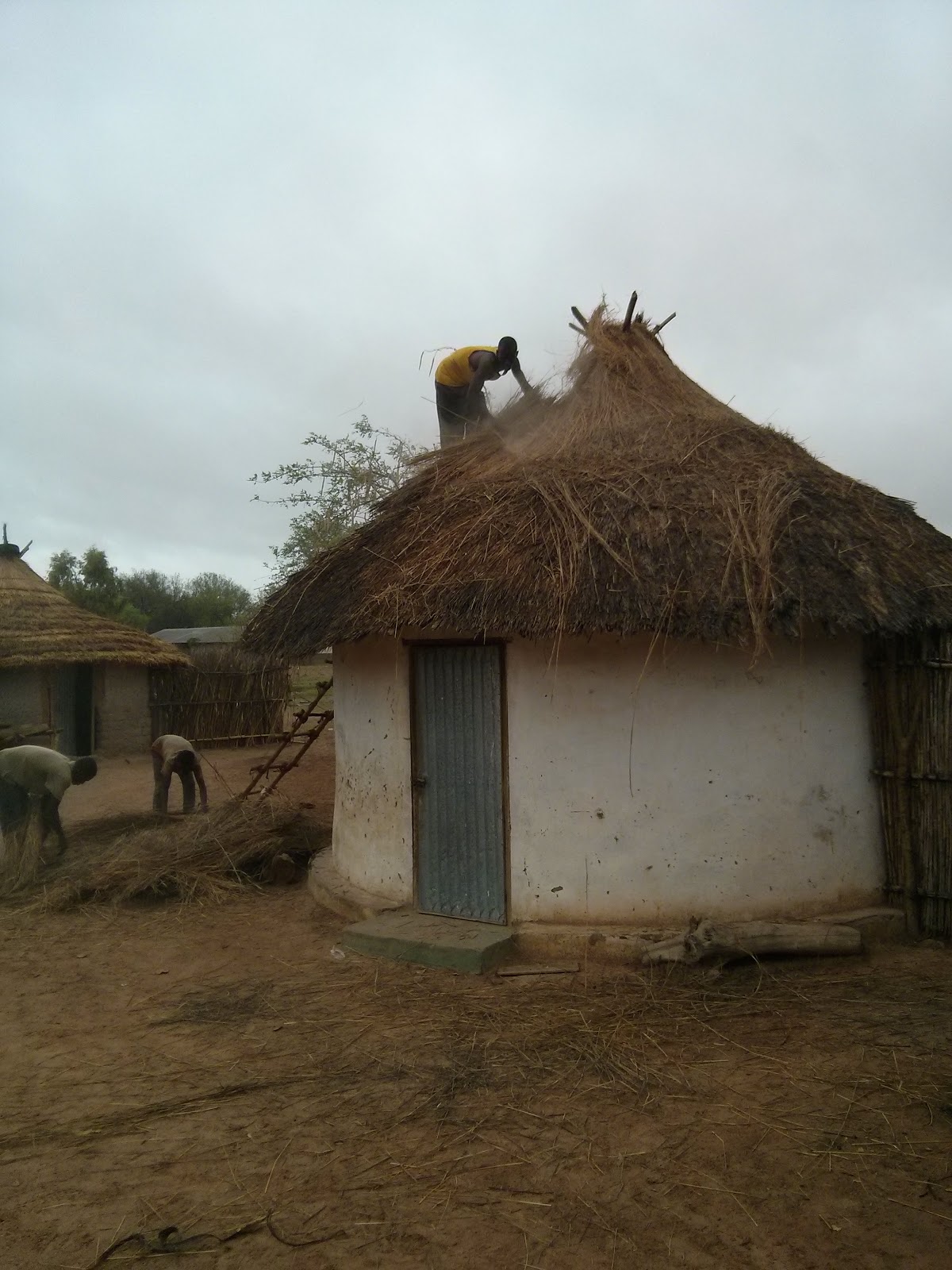
My brother and uncle unrolling grass
The roof almost done
What it looked like inside
Just before the rainy season my dad had my brothers put a new roof on my hut. The old one seemed to me to be working just fine, but everyone who came over would mention that it was old and should be replaced. There was only one spot where water came in, but every time I left, lots of dust and stray grass would fall down on the floor. The roof is made from a thick, long grass. Its not the nice soft stuff that grows around town. It comes from the swamp and is pretty thick. After the harvest and rainy season are over, people will pass by the swamp as often as possible to cut a donkey cart full of grass and bring it home. They leave it out for a while, and then they start tying it together by braiding a long peice of bark through a handful of grass at a time. When they finish the grass lays out like a long rug, and then it gets rolled up and put on top of the donkey house until its reasy to be used. All of the thatched roof huts have to be replaced every few years, and there are a few others in my compound that seem worse off than mine. The rains werent very heavy last year, and so there wasnt as much grass available this year. Since Im the guest I got the new roof, while others just got some patches. My unle and brother began by climbing up to the very top of my roof, then they just start rolling the sheets of grass off and throwing it down. On the ground my uncles kids and my other brother roll it back up, and carry it off to use for something else. They peeled it all the way down the last few layers, and then they knocked the frames all over with a hammer to knock off all the termites and dust. Then one by one a fresh roll of grass gets thrown up and rolled out, until it reaches the top. The top point is then tied together and bound either with a bottomless bowl, or old tire. The alternative to these grass roofs is corrugate. The corrugate buildings get really hot during the day in the hot season, and I wondered why anybbody would want one. After seeing all the work it takes to replace a grass roof though, I understand.
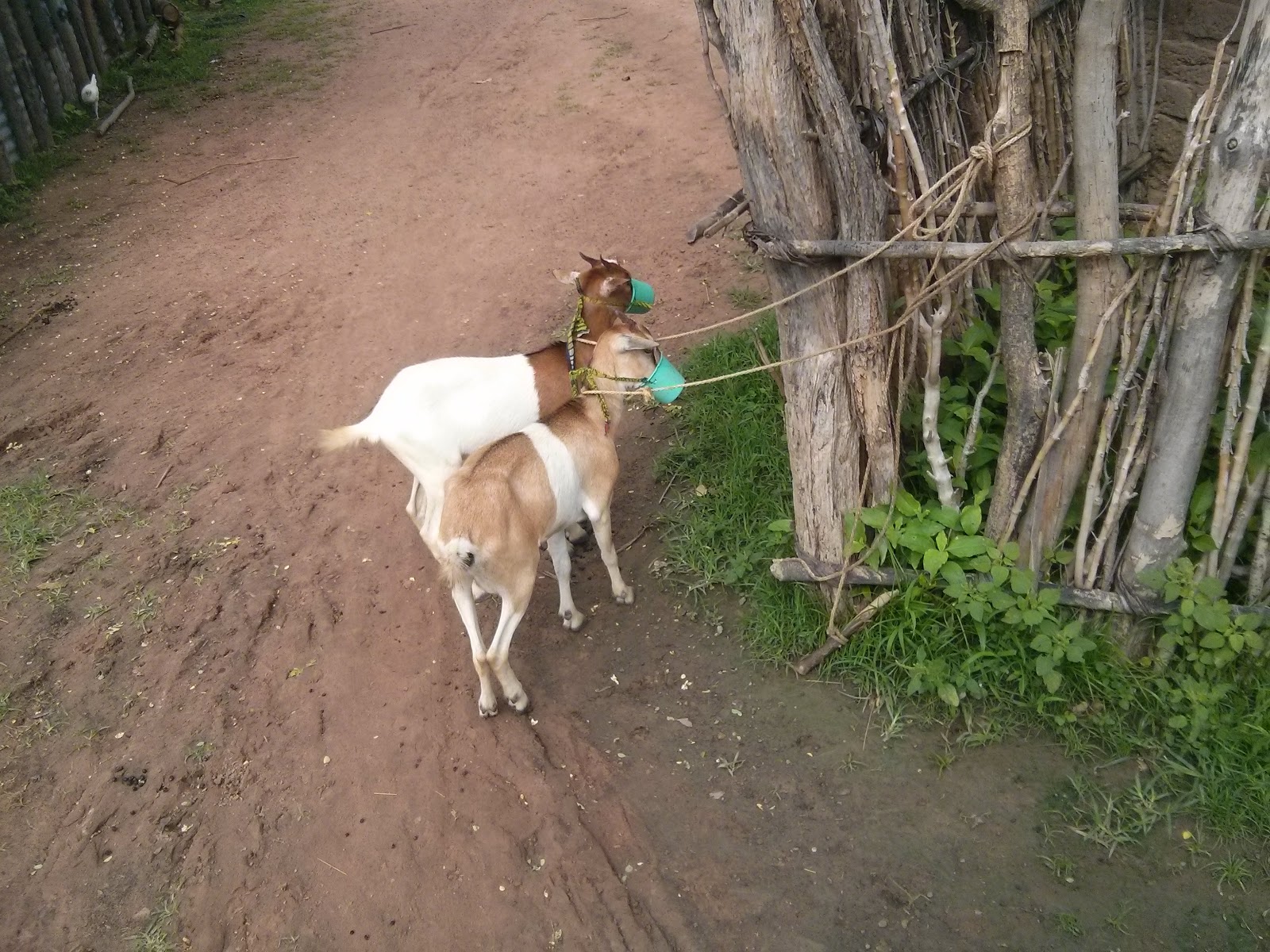
Killer Goats
The above goats are muzzled and tied to the fence. They are muzzled with plastic cups, that have holes punched in each side and a string tied through the holes. They look kind of like the oxygen masks that are supposed to drop down on you in an airplane cabin. Most of the time all the masks are hanging in the women´s huts. When the women head to their oeanut field in the morning, they will take all their goats with them. They tie them up with these masks though to keep them from eating peanuts, corn, and millet as they make their way out to the field. Once they get out to the field they will tie them up near a patch of green grass and take the mask off, letting the sheep or goats graze while the women work in the field. During the dry season all of the animals are left to their own devices. When they wake up in the morning they all leave, and return slowly in the evening. The only help they get is a bucket of water when they get home, or congregate near the well. Once the crops are planted and start to come up, a village law goes into effect that all animals have to be tied up. If you find someone elses animal ranging free, you are suposed to corral them and take them to the alkalo (village mayor). The owner has to pay 25Dalasi to collect the animal. It seems to me most people avoid this fine and take the animal straight to the owner. There they often yell at the owner and tell them that next time its staright to the alkalo.
Friday, July 3, 2015
Tida's New Baby
Tuesday, June 30, 2015
The Saint Louis Jazz Festival
Neeto
Friday, April 3, 2015
My Dad's Gun
Thursday, March 5, 2015
My Dad Visits: A Travel Journal
The SheepHerders
Monday, January 12, 2015
My Sister Bintu
When a husband is not around his brothers and friends will all take care to look in on his bride. People just come by to chat and see if any help is needed, or if they can pass anything along to the husband. Since I was friends with Ensa, and Bintu was my sister it was really no chore for me to spend a little extra time with her. I went out with her a few days to weed and plant her peanut field, but we really connected on the cloudy days when rain was imminent and no one went to work. I would take my book into the hut she and my grandma/aunt share and sit across from them reading, napping and chatting until the rain would come and I'd leave to shut my windows and doors and wait out the storm.
In the last week of September I decided to make a trip to Kombo to welcome Malcolm back when he returned to the Gambia after going home for a few weeks. It was a small vacation, but I didnt feel bad about leaving. I took time to hang out with my sister, and I was taking time to come hang out with another friend. I spent four days in town. On the morning I got up to head to the bus station to come home I got a text message that said my sister had given birth the night before, but after delivering the baby died on her way to the hospital in Basse.
Bintu's Baby
In early November I was out one morning stacking peanuts with the same aunt who breastfeeds the baby. It was afternoon, but not quite lunch time or time to go home. I was taking a break and my aunt told me to get up and let's go home. I noticed that everyone else was headed home too. I thought maybe the pumps were on and everyone was going home to get water. Something was definitely happening, and when I got back to the village I found out that a young boy from the new Sami had just died. His father was the bread baker and we had become friends earlier in the year, so I really made a point to attend the funeral that evening.
The funeral took place at dusk and it was dark when I got home. My aunt was sitting next to my house and before I could go inside she said my name. I walked over to her and she told me "Tunko has died". We immediately went right over to his compound and people were already gathered there. It was dark, but after praying he was taken to the graveyard and his father laid him in the ground right next to his mother.
I walked home late and the day had put everyone in a pretty somber mood. I went inside to eat dinner and get ready for bed. Before I could get there the sound of crying in the village brought everybody back outside of their huts to the middle of the compound. My dad and uncle went out to find out what was going on. My sister came running into the compound a few minutes later and told us the news. There was a mother of six from another compound who had never recovered from the birth of her last baby. She passed away and was the third death in our village in one day. Nobody hurried back inside to sleep, we all just sat outside together in silence.
Wednesday, January 7, 2015
The American Holidays
The Tuesday before Thanksgiving there was a small get together in Basse. I didnt consider going, until the day of when I talked to somebody there and thought about how it might be nice to be with people, eating alot, and enjoying the day like Im used to. So on Thanksgiving day I told my family it was a holiday, and took off on my bike to meet Malcolm for a holiday ride. We took a big loop around the area -one we had done before- a little slower though and talking about home and people we know a little bit more.
By the time Christmas came around I considered taking a vacation to Senegal and completely foregoing the holiday to visit some people from my village who were working there. Im glad I didnt make it though. Selina -whom I came here with and lives an hour down the road- invited me over to her house. She had Malcolm and Alicia, who used to live in our area too, over as well. On Christmas day I met Malcolm on the road and we rode to Selinas in the late afternoon. Her and Alicia were in the backyard getting dinner ready. On her clothesline hung a picture of a Christmas tree, one of a bicycle for me, and one of Black and Mild cigars for Malcolm. We sat outside talking and keeping an eye on the food as the sun went down. Then two of Selinas local friends came over, and she served us all dinner. We had beef, macaroni salad, stuffing and potatos for dinner. Everything was either expensive or imported. I was full after one plate but ate until I had three. Then the six of us laid out on a mat in the backyard talking and looking at the sky.
I really enjoyed Christmas because it was small, but still felt like a holiday because we got together. It was also neat because her host family got to be part of the celebration and wish us all a Merry Christmas without having to do anything out of the ordinary. A few days later a volunteer from Soma called and said he wanted to come visit. I told him to come for the next holiday, New Years, and invited Malcolm and Paige - a close volunteer who lives in Alicias old town- and told them to come over too. I let my family know I wanted to have guests. They were thrilled and showed it by cooking a huge dinner of rice, green sauce and fish for New Years. Then we all sat outside drinking attaya and hot sweetened condensed milk until a couple hours past when we would all normally go to bed. Then me and my guests went in to my hut and sat around on the floor talking until the last of our watches said it was 2015.
Our Christmas Presents
Selina working on dinner
Fatoto Lumooto
On a normal day you can get most things in town which means rice, oil, peanuts, attaya, sugar, batteries, lamps, soap, and maybe some onions. Lumoo days bring mobile phone and radio sellers. Used clothing, fabric and soccer jerseys are available. There is jewelry and makeup, soccer balls, cleats and flip flops. This is also the day to buy iron cookware. Vegetable sellers bring all their produce, and in each corner in town women are selling bananas, beans, and pancettos. Although my list never includes some of these special items, its the only day I go to do my shopping.
Malcolm and I started meeting up here on our first Sunday in the villages. On the first day we were quickly overwhelmed and looked around and left. We went down to the river side and sat for the afternoon. Sitting by the river has become a full day activity in itself, as has being a part of the lumoo. I leave the house early to bike ride, read, write, or call Zabeth while its still early. When I arrive at the lumoo around noon I park my bike at a tailor's- Bakary Camara. Its next to a small shop that serves hot water for coffee. After greeting the tailor and having a snack I move up to the produce to buy peanut butter. I greet most of the women selling and move on to buy coffee and powdered milk for the week. I always make at least one lap around greeting the people from my village and picking up anything else that comes up.
After the shopping is done I walk up and sit with another tailor I know. Hes in 12th grade and speaks good English and lets me sit inside of his shop for the afternoon. I'll get up when the market starts to shut down around 5. Then reverse my lap saying bye to the produce sellers, then the shop keeper that serves coffee, and on to Bakary before buying tea and sugar to take back to my family from the market. Then I get on my bike and try to ride home in time for dinner.
Monday, December 15, 2014
Wednesday, December 10, 2014
The Peanut Harvest
Is an entire family affair. Up to this point the peanut work has been mostly the women's responsibility, while the millet fields were worked by the men. Each woman in the compound has her own field. After a few weeks of rain, they will go out and begin weeding. Its a lot of work so generally two or three women will team up to work on one field. When it's clear the men lend a hand by driving the plows through before each woman plants. Women then weed their own fields ( or in teams) until the peanuts are big enough to out compete the weeds. The men are doing the same in the millet fields. When everything has outgrown weeds, there is a break in work until it stops raining. Then when it stops, each woman is responsible for getting her own peanuts out of the ground. Since the millet takes longer to mature, the men will go out together every day and help pull peanuts in one woman's field. It takes 2 or 3 days in each field before all the peanuts are up. They rotate through the fields by age of the women, oldest first. The days when men aren't in a woman's field she will still work pulling more up, stacking them to dry, or sweeping the ground for loose nuts. When all the peanuts are up a woman will stack them in a big donut, then the men will come around and build a big huge mound for them to dry out. The mound is covered with thorns and grass to keep goats and cows out. When its time to work the stack, all the men and women take two sticks that look like canes held backwards and pull peanuts off the top of the stack. They walk backwards beating the pile they pulled down until the ground is a a carpet of peanuts, and the stalks are stacked behind you. The work divides again as women pick up and drop bowls of peanuts letting the wind blow away the pieces of dirt and stalk. The men do the opposite, dropping the stalks to clear out peanuts so that they can carry home a big mound of stalks for the donkeys to eat. It goes until all the nuts are cleaned and bagged. Then the men load up the donkey carts and the women head for home on foot
Monday, November 24, 2014
The Harvest
I have never been part of a harvest before and its that time of year in Sami Koto. About 1 month ago people started pulling peanuts out of the ground, but that was less of a harvest than just another step in processing them. Now that all the peanuts are up the real harvest has started in the millet fields. The millet stands about 8 or 9 feet tall and has been drying out since the last rains well over a month ago. Every morning around 630 all the males leave the compound on the donkey cart. When they arrive at the fields, they walk through and knock down all the stalks they plan to harvest for the day. Our family is working with our neighbors, the Keita's. So all the men spend 2 days working one of their fields, and then 2 days working one of our fields. The work in the field is divided by age. All of us in our 20s and 30s will cut the grains off the stalks. When you fill your non cutting hand up, everyone makes a pile on the ground. Then all the kids will pick it up and carry it through the field to a shade tree. Under the tree is a big tarp made of rice bags. All the grain is stacked there, where the oldest men from each compound sit on the ground tying all the stalks into bundles. Everyone moves pretty quick at least early in the day. The men are walking and cutting and the boys are almost running to move the grain before it piles up in the field. Though everyone is moving, there is a lot more joking and talking than there was while pulling peanuts. Around noon or one when all the during is done everyone moves under the tree to finish tying. Someone will go tie the donkeys to the carts and walk them over. We load each cart with about 40 bundles, and each day we have around 90 bundles. When all the millet is up, we parade home on the carts, on bikes, and on foot. Everyone arrives home and stacks the bundles on the donkey house to dry in the sun before its put up for the year. Whichever compound gets the harvest that day will serve lunch to all who worked, and everyone rests til tomorrow.
Monday, November 10, 2014
Barnum
On Tuesday evening (dates irrelevant) as I was walking by my dads hut he said to me: Tomorrow, we are going to greet a visitor. He doesn't ask much of me so I said sure, I'll be there. He told me the name of the village and the name of the man hosting the visitor. The host cones by our compound quite often to say hi, so I was happy to be returning the favor. My dad also let me know the guest was from Germany, which I took to mean as a Gambian who had found work in Germany.
I got up extra early Wednesday morning, and made a point to come outside before 7 30 to let my dad know I was up and ready. At 8 he said let's go, so I pulled out my bike as he strapped a chicken across his handlebars to give to his friend. On the way I considered things like do I have enough water, what would I be doing at home right now, and how long do I have to stay. The usual considerations when someone else asks you to do something. I figured none of the answers mattered too much as I could handle anything for one day. When we pulled in, I saw a pair of white legs standing across the compound. I thought oh, I guess the guy from Germany brought a friend too. But as it turned out he WAS the visitor from Germany. He was married to a woman from the village, and it wasn't the first time he had been to visit, as my dad knew his name, Barnum. After they served us breakfast, I sat down with him and talked for almost two hours while my dad waited as a patient observer of the conversation. Its the spot I'm usually in, and had assumed I would be in again. Then my dad gave me the signal, and we departed with an invitation to come back and stay the whole day.